


Page 53 - 23rd Convocation Booklet
P. 53
•  Privacy and the DPDP Act: Navigating the legalities of the Digital Personal Data Protection
                  Act in an Indian context.
               •  Accountability:  Reaffirming  that  while  AI  can  suggest  a  diagnosis,  the  final  professional
                  responsibility always rests with the clinician.

           Phase 5: Governance and Leadership


           The final modules, including Module 20, prepare clinicians to lead multidisciplinary AI teams. This
           involves  understanding  how  to  monitor  AI  performance  after  deployment  and  ensuring  that

           technology enhances rather than disrupts organizational workflow.


           Academic Synergy: Global Faculty and Local Impact

           The program has leveraged a "Global Faculty," bringing in experts from the Mayo Clinic, Harvard,

           Oxford, and India’s premier institutions like IISc Bengaluru and IIM Lucknow, ensuring that the
           knowledge delivered is world-class.


           This multidisciplinary collaboration ensures that participants are exposed to global best practices
           while remaining grounded in the regulatory and cultural frameworks of the Indian healthcare system.


           NBEMS  has  maintained  its  hallmark  of  academic  discipline  throughout  the  programme.  The

           guidelines for participation are stringent to ensure genuine competency.

           The Roadmap to 50,000 Healers


           The ultimate vision of this programme is a massive scale-up of India's medical capacity. The roadmap
           targets training 50,000 doctors across the country, structured through a "Train the Trainer" model.

                                                                             This  cohort  is  divided  into

                                                                             15,000  master  trainers  and
                                                                             35,000 trainees, creating a self-

                                                                             sustaining network of informed
                                                                             stakeholders     capable     of

                                                                             governing  and  building  India-
                                                                             specific AI solutions.


                                                                             Already,  the  enthusiasm  is

           palpable;  over  68,000  healthcare  professionals  across  the  country  registered  for  this  online
           programme, reflecting a sea change in the professional culture of Indian medicine.


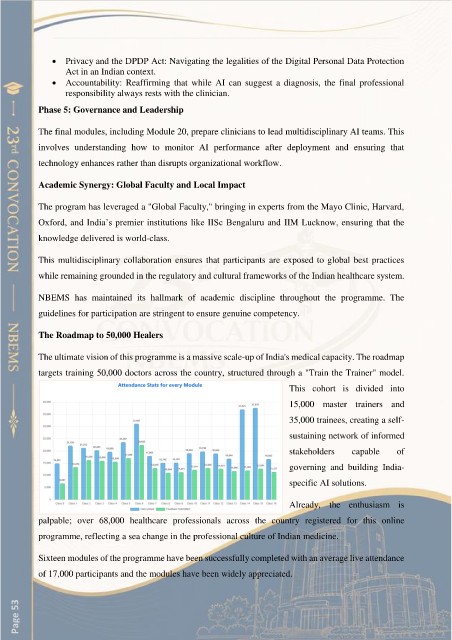
           Sixteen modules of the programme have been successfully completed with an average live attendance

           of 17,000 participants and the modules have been widely appreciated.


      Page 53

